
The layout of tables and chairs determines how a meeting goes. A boardroom works for discussion, a U-shape for training sessions, a theatre layout for presentations to a large group. Choose based on what you want to achieve: talking, learning or listening.
The same room can feel like a courtroom, a classroom or a living room. The difference is in how the tables and chairs are set out. The layout determines who faces whom, whether people join in or mostly listen, and how many people fit. Which layout do you choose for your meeting?
Start with the purpose
First ask yourself what the participants will be doing.
- Talking and deciding? Choose a layout in which everyone can see each other.
- Learning or practising? Make sure everyone can see the trainer and the screen, and that there is room to write.
- Listening to a presentation? Then what matters most is that everyone can see the stage clearly.
- Working in small groups? Choose separate tables.
Boardroom
One large table with the chairs around it, as in a directors’ meeting room.
- Suits: discussions, decision-making, job interviews and client meetings with a small group.
- Advantage: everyone sees each other, and it feels equal.
- Disadvantage: only works for small groups. A screen at the end of the table is hard to see for some.
U-shape
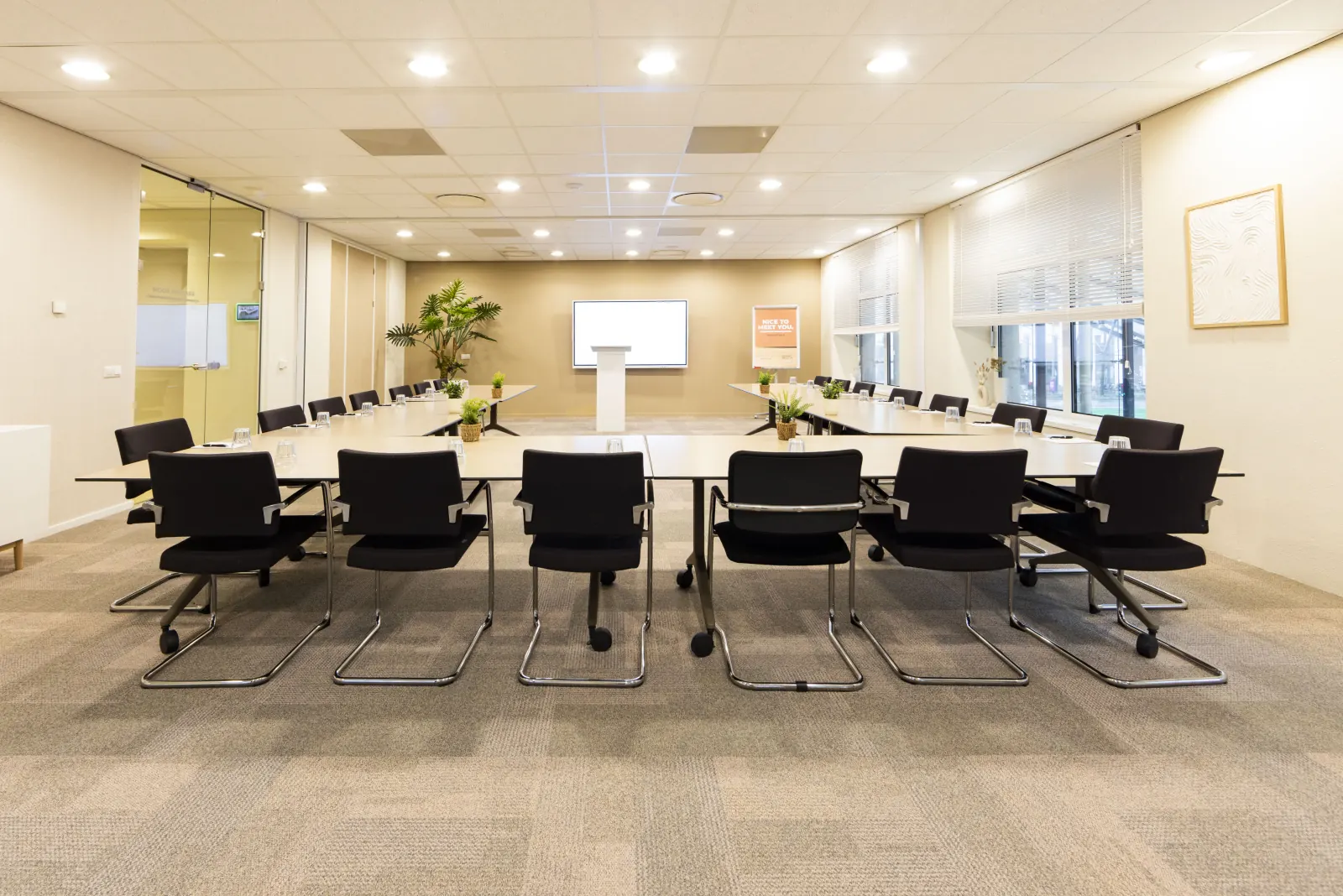
Tables in the shape of a U, with the open side towards the screen or the speaker.
- Suits: training sessions, workshops and presentations with discussion.
- Advantage: everyone sees the trainer and each other. The trainer can walk into the U and get close to the participants.
- Disadvantage: takes up a lot of space for the number of people it seats.
Hollow square
Tables in a closed square or rectangle, with the chairs on the outside.
- Suits: discussions with a slightly larger group, or a meeting in which everyone is equally important.
- Advantage: everyone sees each other, and there is no head of the table.
- Disadvantage: the distance to the other side can be large, and a screen is not easy for everyone to see.
Theatre
Rows of chairs without tables, facing a stage or screen.
- Suits: presentations, lectures and information sessions for a large group.
- Advantage: it seats the most people.
- Disadvantage: no table to write on, and little interaction.
Classroom
Rows of tables with chairs behind them, facing the speaker.
- Suits: training sessions and courses in which participants need to write or work on a laptop.
- Advantage: everyone has a workspace and can see the screen.
- Disadvantage: participants look at each other’s backs, which makes discussion harder.
Cabaret or separate tables
Round or separate tables, with the chairs placed so that nobody sits with their back to the screen.
- Suits: workshops, brainstorms and days in which you switch between plenary sessions and small groups.
- Advantage: easy to switch between listening and working together.
- Disadvantage: takes up a lot of space.
Which layout is best for a training session?
For a training session with a small or medium-sized group, a U-shape is often the best choice: everyone sees the trainer and each other, and there is room for conversation. If participants need to write a lot or work on a laptop, and the group is larger, a classroom layout works. If you alternate between explanation and assignments in small groups, choose separate tables.
Tips for booking
- Ask which layouts are possible in a room, and for how many people.
- Mention the layout when you book, so the room is ready when you arrive.
- If you are planning a whole day with different parts, ask whether there is a second room for small groups.
More tips on choosing a room are in “Choosing a meeting room: what to look out for?” and, for a day away from the office, in “Choosing a venue for a training session or away day”.
Meeting at Element Offices
At our locations you will find meeting rooms in different sizes. For each room you can see how many people it is suitable for and what is included. Which layout is possible differs per room; ask when you book. See the rooms on Meeting rooms.
Frequently asked questions
Which layout is best for a training session?
For a small or medium-sized group, usually a U-shape: everyone sees the trainer and each other. For a larger group that writes a lot, a classroom layout works.
What is a hollow square layout?
Tables in a closed square or rectangle, with the chairs on the outside. Everyone sees each other and there is no head of the table. Suitable for discussions with a slightly larger group.
Which layout seats the most people?
The theatre layout: rows of chairs without tables, facing a stage or screen. Handy for presentations, but there is little room for interaction.