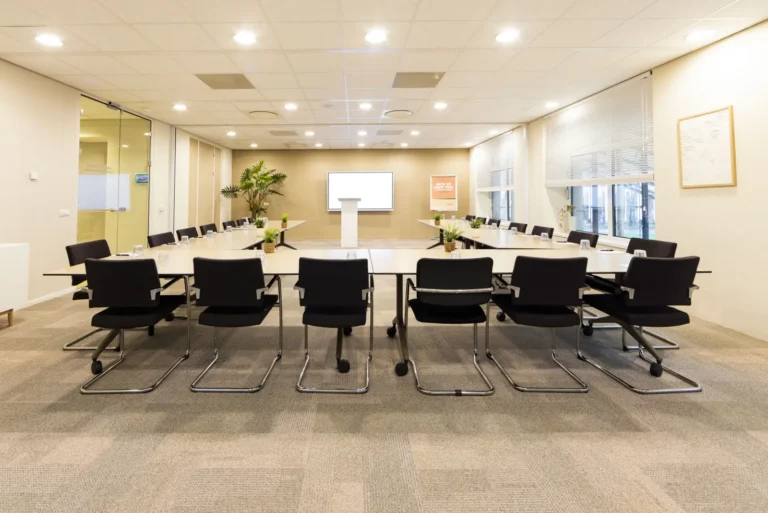


VVO stands for verhuurbaar vloeroppervlak, the lettable floor area: the metres you rent with an office. BVO is the gross floor area of the whole building, including walls, stairwells and plant rooms. Both are measured according to the Dutch standard NEN 2580.
Anyone comparing offices in the Netherlands soon comes across a row of abbreviations: VVO, BVO, NVO. One listing says 40 m², another 40 m² VVO, a third works with net metres. Without an explanation, you are comparing apples with oranges. This article explains what the terms mean and how to use them to work out how much space you need.
What is NEN 2580?
NEN 2580 is the Dutch standard for measuring the floor areas and volumes of buildings. It sets out what you do and do not count, so that two people measuring the same building arrive at the same figure. Estate agents, landlords and valuers use it to state metres in the same way.
The standard contains several terms. For office rental, there are three you will come across often.
What does BVO mean?
BVO stands for bruto vloeroppervlak, the gross floor area. It is the total area of a building or floor, measured along the outside of the external walls. Everything counts: the walls themselves, stairwells, lift shafts, corridors and plant rooms.
BVO mainly tells you how big a building is. For a tenant it is less useful, because you will never use part of those metres yourself.
Looking for an office?
See offices with the metres per office
What does VVO mean?
VVO stands for verhuurbaar vloeroppervlak, the lettable floor area. These are the metres a landlord can let to a tenant. For offices, VVO is the measure the rent is usually based on.
Under NEN 2580, a number of parts of the building do not count towards the VVO, such as:
- stairwells, lift shafts and voids;
- spaces for building services;
- free-standing service ducts above a certain cross-section;
- parts of a room lower than 1.5 metres.
In a building with several tenants there is often something extra: a share of the shared spaces, such as an entrance, pantry or corridor used by several tenants. That share is divided proportionally. As a result, the VVO of an office in a multi-tenant building is often larger than the space behind your own door.
What is net floor area?
The net floor area (NVO, netto vloeroppervlak) is the area between the walls, measured at floor level. It comes closest to what you see yourself when you walk into the room. Walls, columns and shafts do not count.
If you want to know whether your desks, cabinets and a meeting table will fit, look at the net metres of your own space.
BVO or VVO: what is the difference in practice?
The difference between BVO and VVO can be considerable, depending on the building. The more stairwells, lifts and plant rooms, the bigger the gap. So always compare the same measure. If one listing gives BVO and another VVO, ask for the VVO of both.
Also ask how the VVO is made up. How many metres is your own space, and how many is your share of the shared spaces? Our office cards show this: the total VVO and, where known, the net metres of the office and the share of shared space.
How many m² of office space do you need per person?
There is no fixed figure. The Dutch Working Conditions Act (Arbowet) does not prescribe a minimum number of square metres per employee. There must, however, be enough space to work safely and healthily and to move around. The standard NEN 1824 gives guidelines for the workstation itself, such as space for the desk, screen and chair.
How much you need depends on how you work:
- Does everyone work at the office every day? Then each person needs their own workstation, plus space for meetings, storage and walkways.
- Does your team work hybrid? Then you often need fewer workstations than you have people. There is more on this in “Hybrid working: how much office do you still need?”
- Are you in a business centre? Then you share meeting rooms, a pantry and a lounge with other tenants. You do not need those in your own office, so you can manage with fewer metres of your own.
A handy approach: count how many people work at the same time on a busy day, decide whether you want to hold meetings in your own space or in a shared meeting room, and then look at the number of workstations an office has. Our offices often list that number.
Reading the metres at Element Offices
Every office on our Office space page shows the VVO. Where we know them, you also see the net metres of the office itself and the share that is shared space. Not sure whether an office is big enough? Book a viewing and work out together with us how your team fits in. For more tips on comparing offices, read “Renting office space: what to look out for?”
Frequently asked questions
What is the difference between VVO and BVO?
BVO is the gross floor area of a building or floor, including walls, stairwells and plant rooms. VVO is the part a landlord can let. For offices, the rent is usually based on the VVO.
How many m² of office space do you need per person?
There is no legal minimum. It depends on how often your team is at the office, whether you hold meetings in your own space and whether you can use shared spaces. Start with the number of people who work at the same time on a busy day.
Does the corridor count towards the VVO?
A corridor that belongs only to your space counts. In a multi-tenant building, shared corridors and spaces are often divided proportionally among the tenants. Ask the landlord how the VVO is made up.